Even though it has been hot and dry I have been keeping our garden going. Today I planted 16 Hatch green chili plants. I got the seed from one of the brethren in Hatch, NM when we were there and planted some of the seed when we got back. It can take up to 40 days to germinate, so had to wait on that. Then I took the seedlings and put them in their separate containers allowing them to continue to grow until they were ready to be transplanted. So now if I can keep them alive in 2-3 months we should have some nice chili (They take a long time to put on fruit.). Monday I will start my third week of classes as we finish up Ezekiel and the following week begin Daniel. Today was the hottest day of the year so far reaching to 89. With the temperatures being in the upper 80″ and very dry even the grass is beginning to dry up. We are more like mid-May instead of mid-April.
Visitors are always welcome to the Chimala Mission
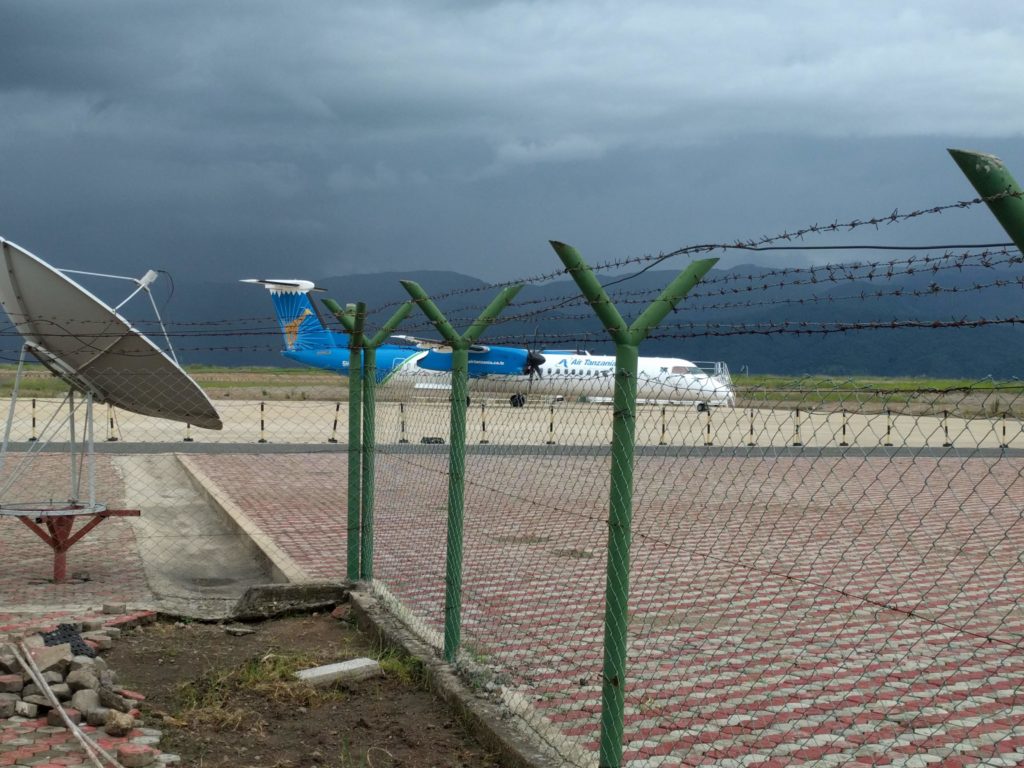
Air Tanzania plane bringing Chad, Graham and Campbell Scott, and Charles “Chig” Gunter to Songwe Airport in Mbeya.
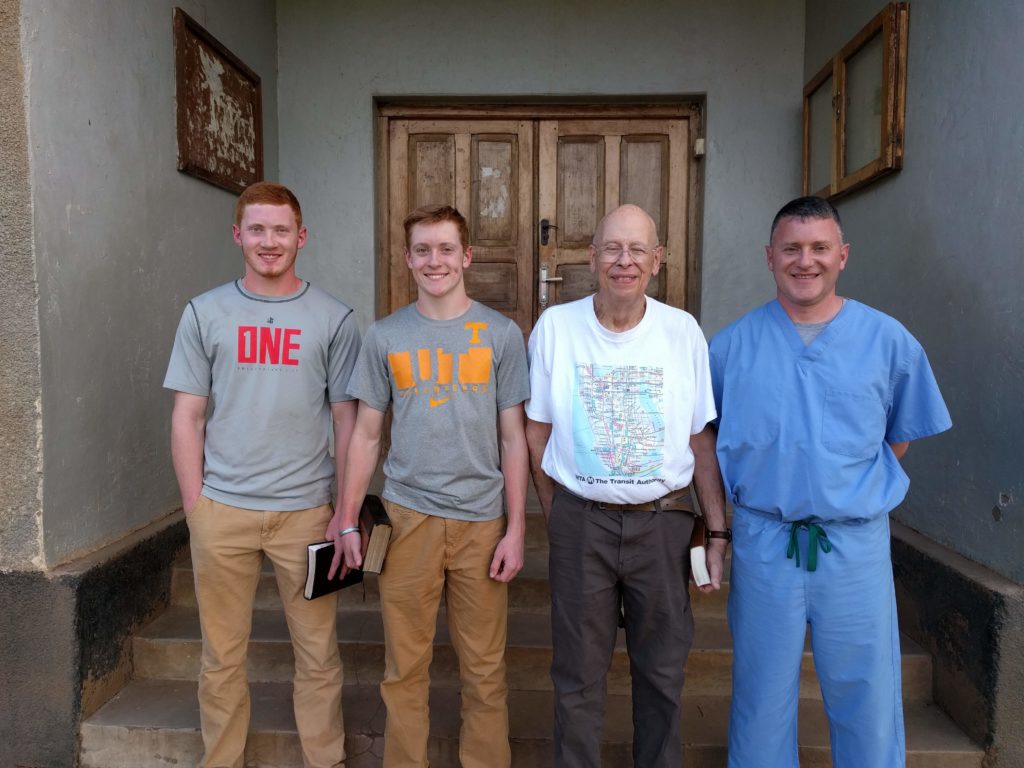
Graham, Campbell, Charles, and Chad before the front door of the mission congregation.
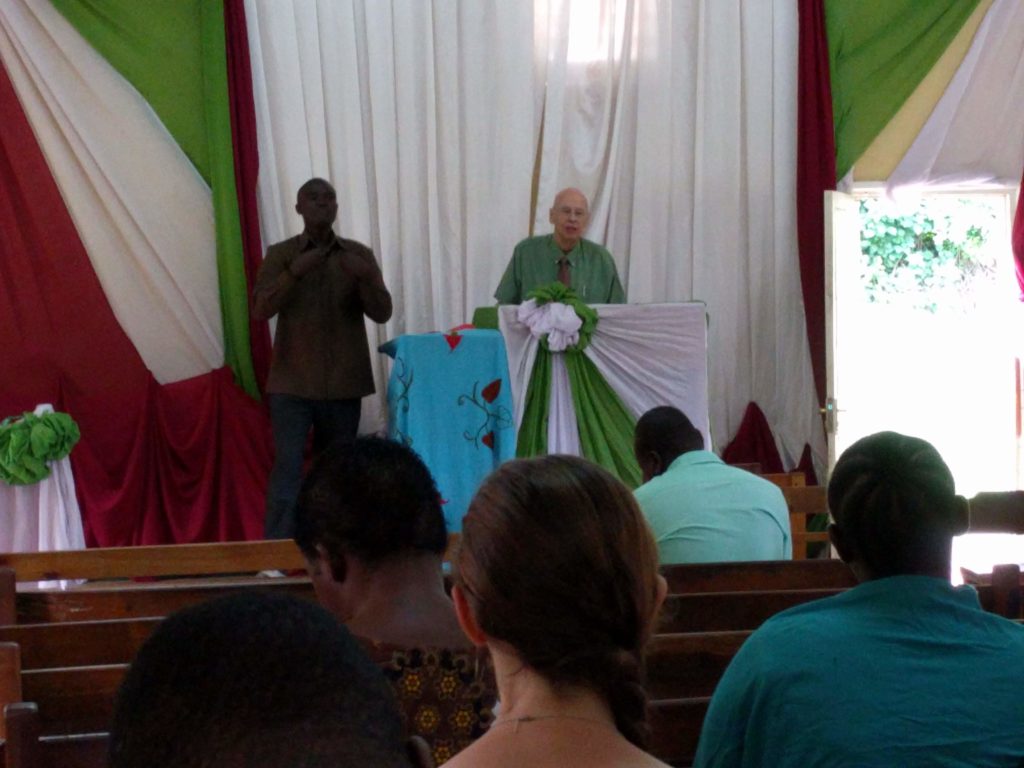
Charles teaching Bible class at the mission congregation.
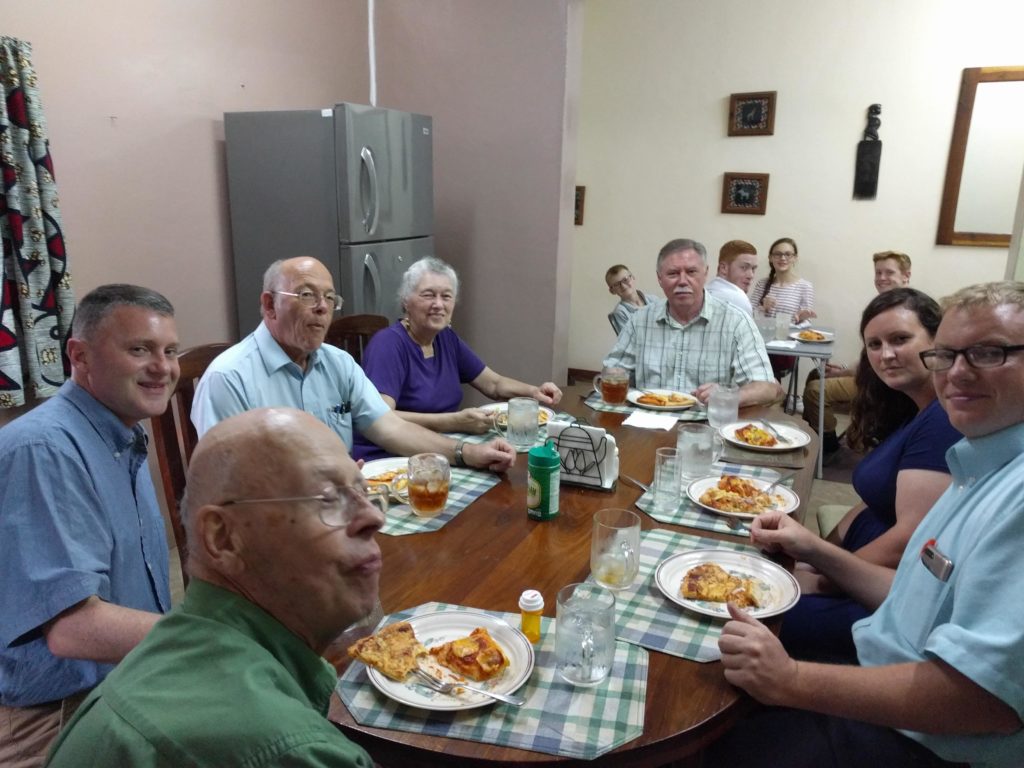
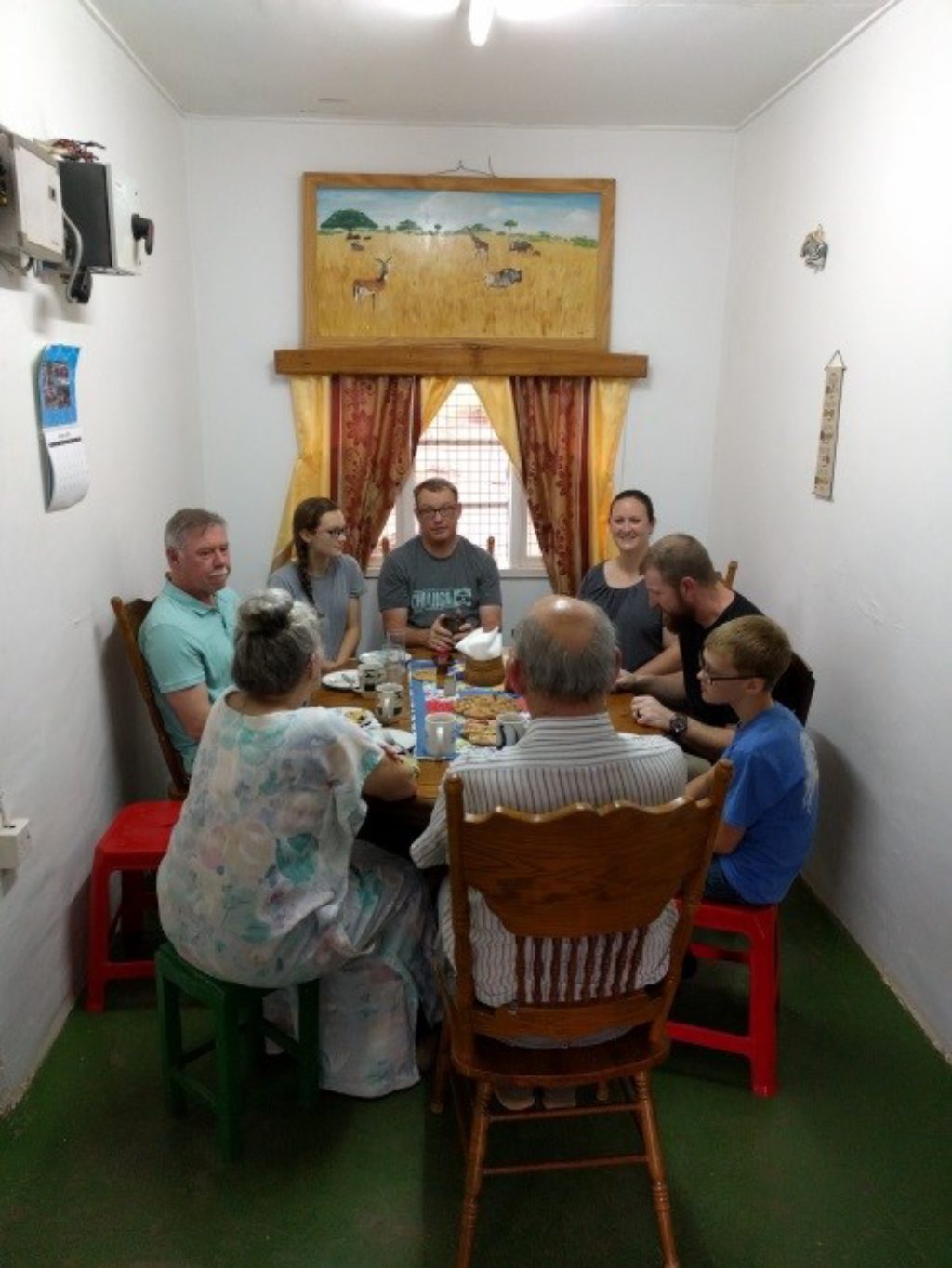
Enjoying a Sunday night of good food and fellowship.
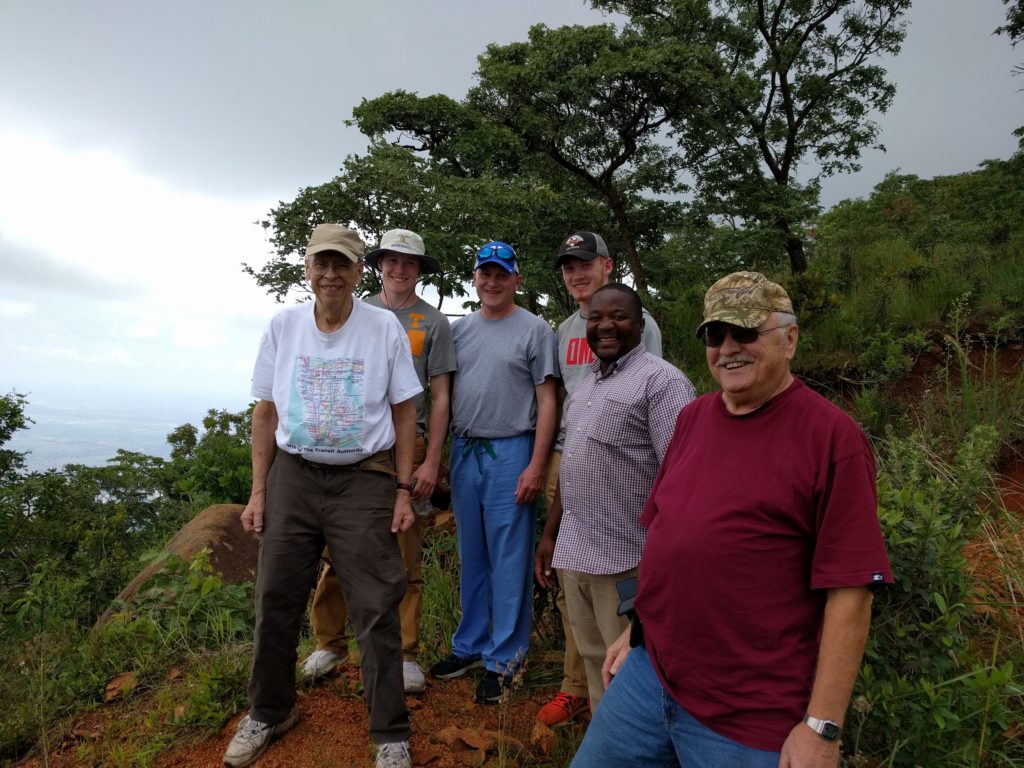
Stopping about half-way up hamsini-na-saba to the Ailsa farm. Jim Kerns from Parkersburg, WV and Ephron Mbano of Malawi (2 on far right) visiting also.
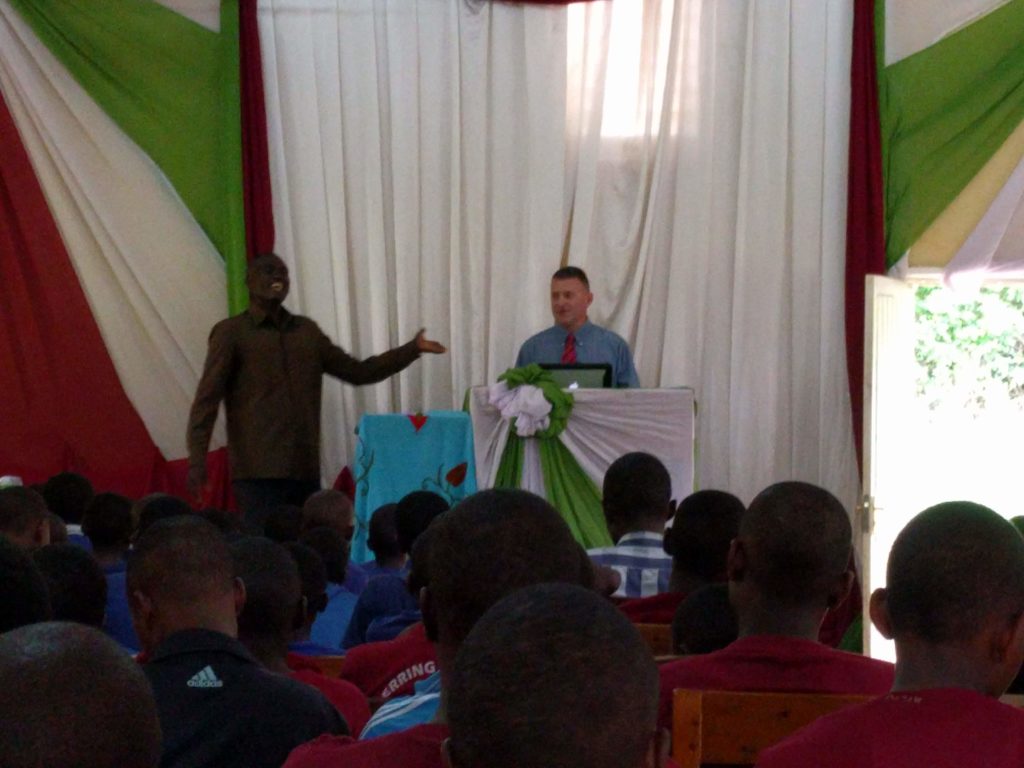
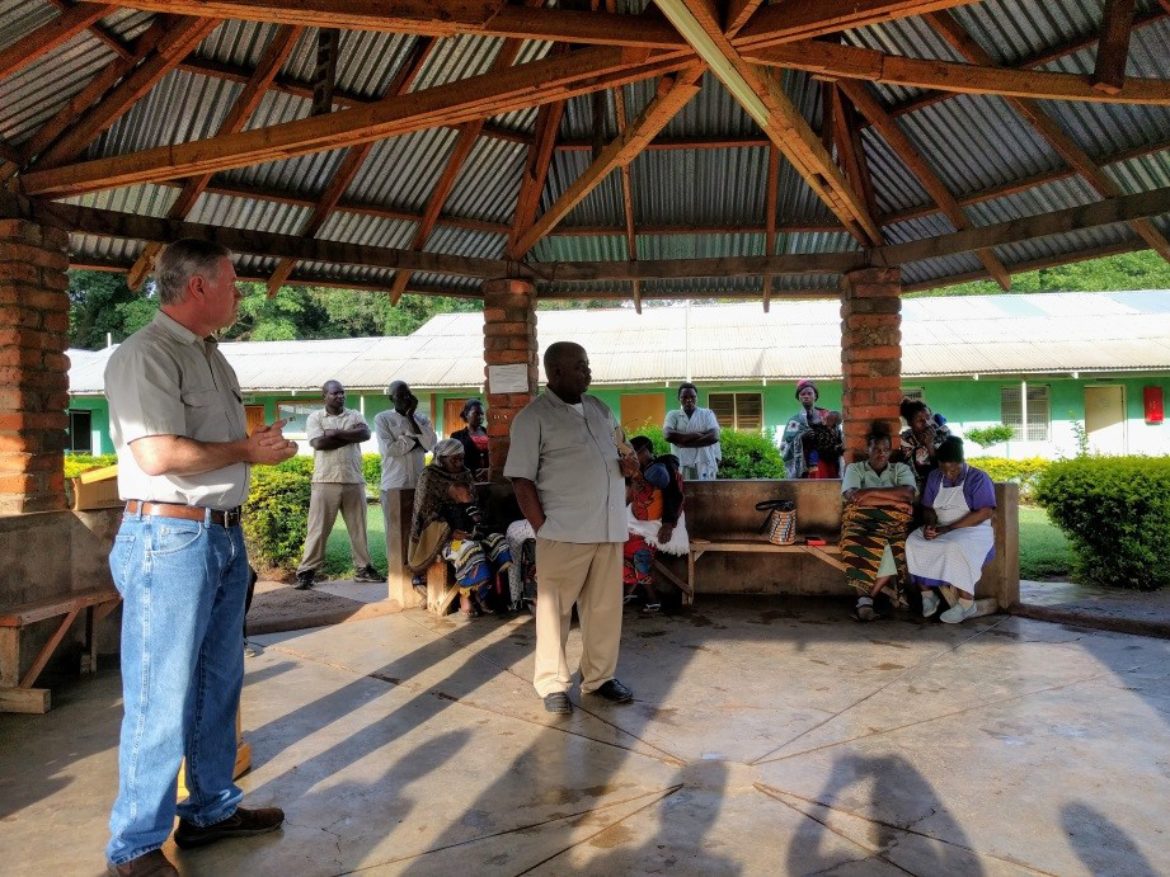
Chad preaching Sunday night with Boaz translating.
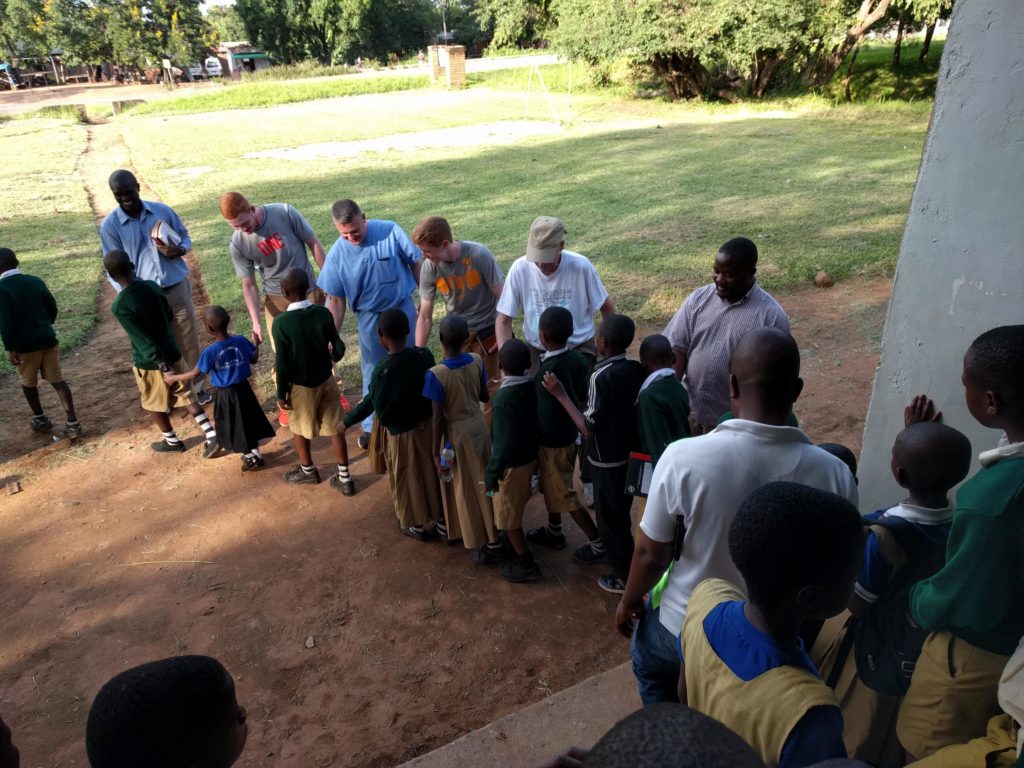
Chimala mission children greeting our visitors for the last time before their next destination.
Greg Knight visiting Chimala to help Gage with the farm project.
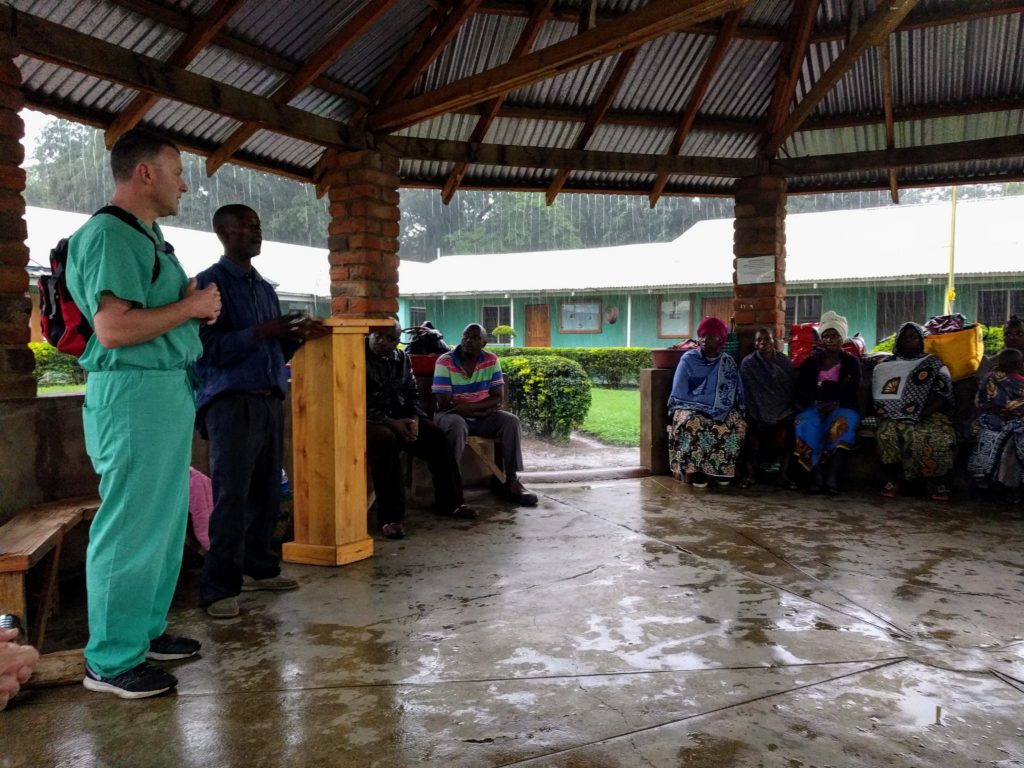
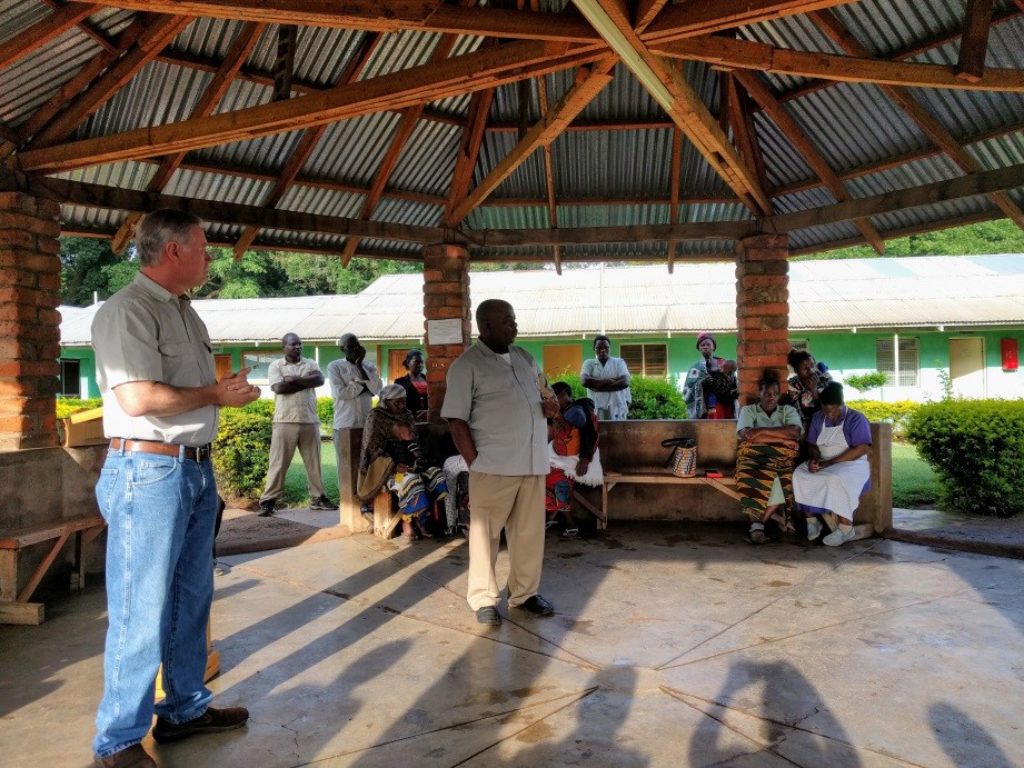
Chad Scott speaking at the mission hospital chapel before working at the hospital.
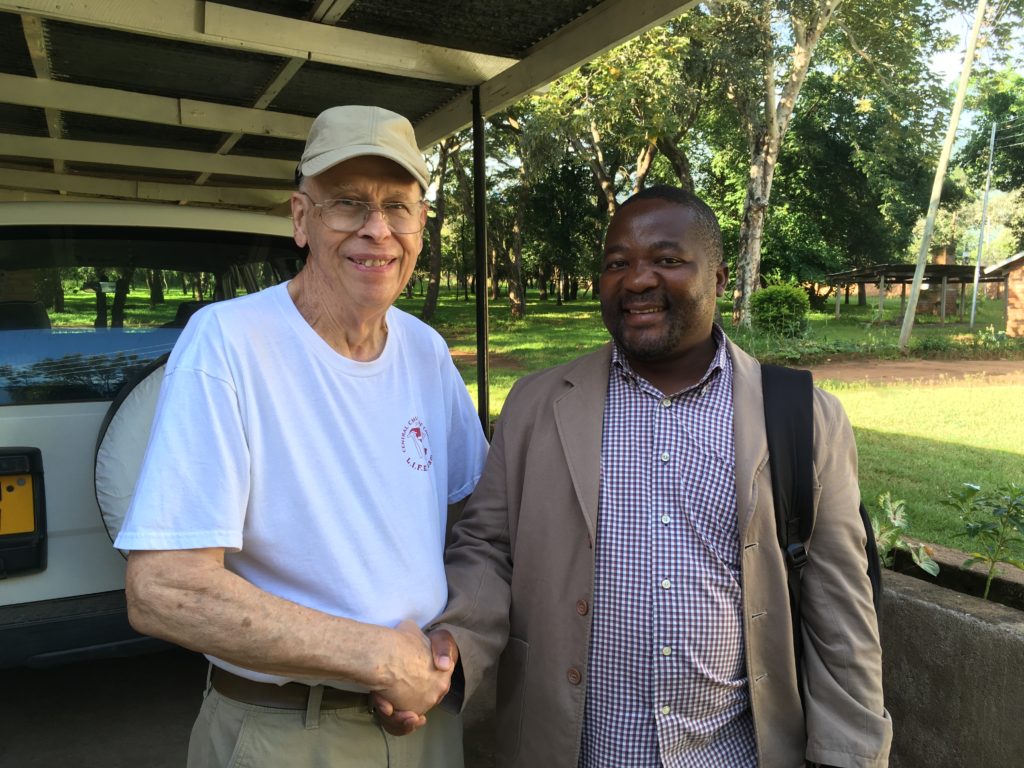
Interesting story: Charles Gunter meets WBS student, Ephron Mbano, for the first time!
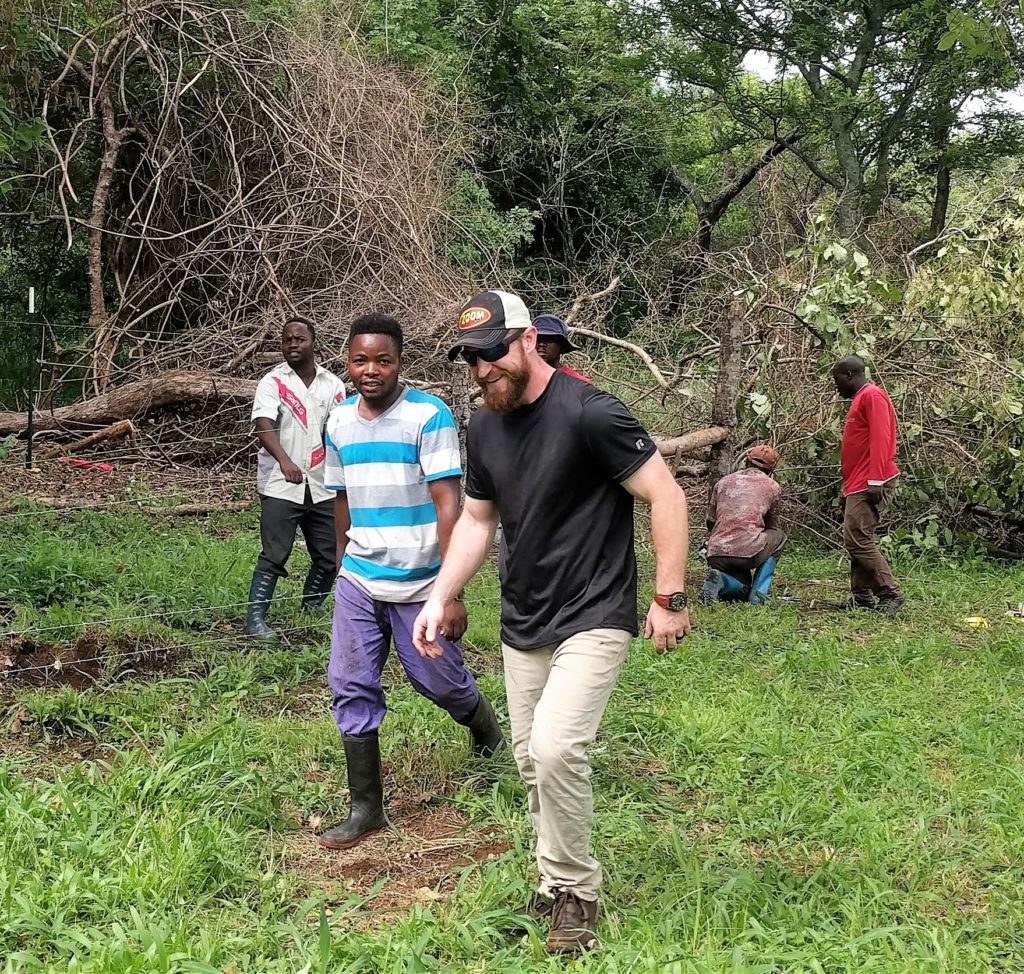
Also visiting to help Gage with the farm project (putting up livestock fencing) was Lee Wright.
Sometimes Gage Coldwater teases me about how many meetings I have to call. It’s all in fun – you have to have a sense of humor to do mission work! But when you consider the magnitude of this mission—a 120-employee hospital that touches the lives of 60,000 patients per year, 700 primary and secondary students plus teachers and staff, missionaries, 30 CSOP students and staff, and a host of doctors, matrons, cooks, cleaners, gardeners, farm workers, carpenters, plumbers, electricians and guards on a 720-acre estate—understanding the numerous things that occur at the mission every day is of upmost importance.
Just to name a few: teaching, preaching, tending to the sick and injured, learning new farming techniques, edifying, staff meetings, assemblies, repairing or making something, giving, receiving, asking, explaining, praying, listening, digging, baptizing, examining, giving birth to a newborn, mourning the death of a loved one, singing, eating, laughing, crying, driving…..you can literally get the picture in the images below:
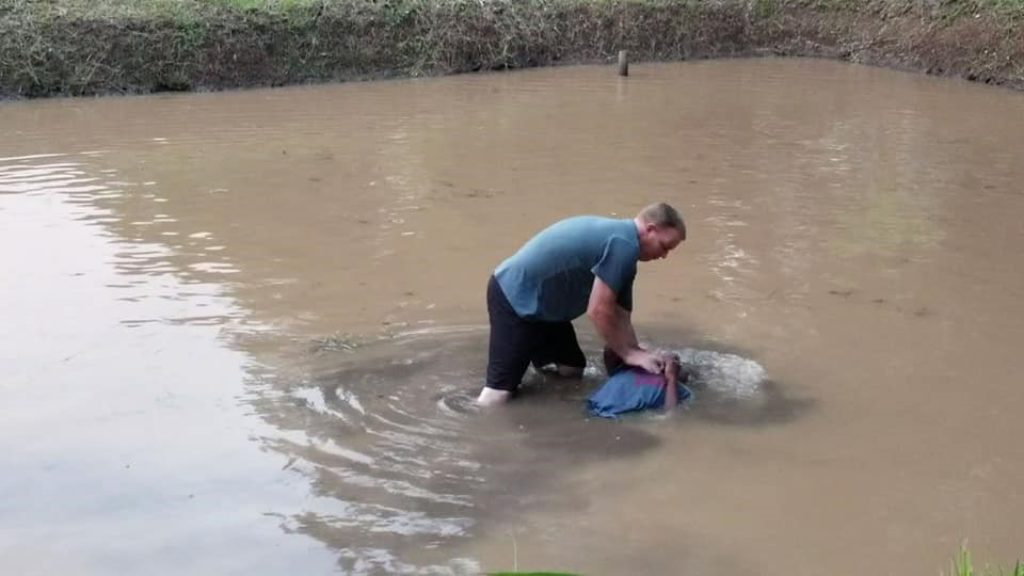
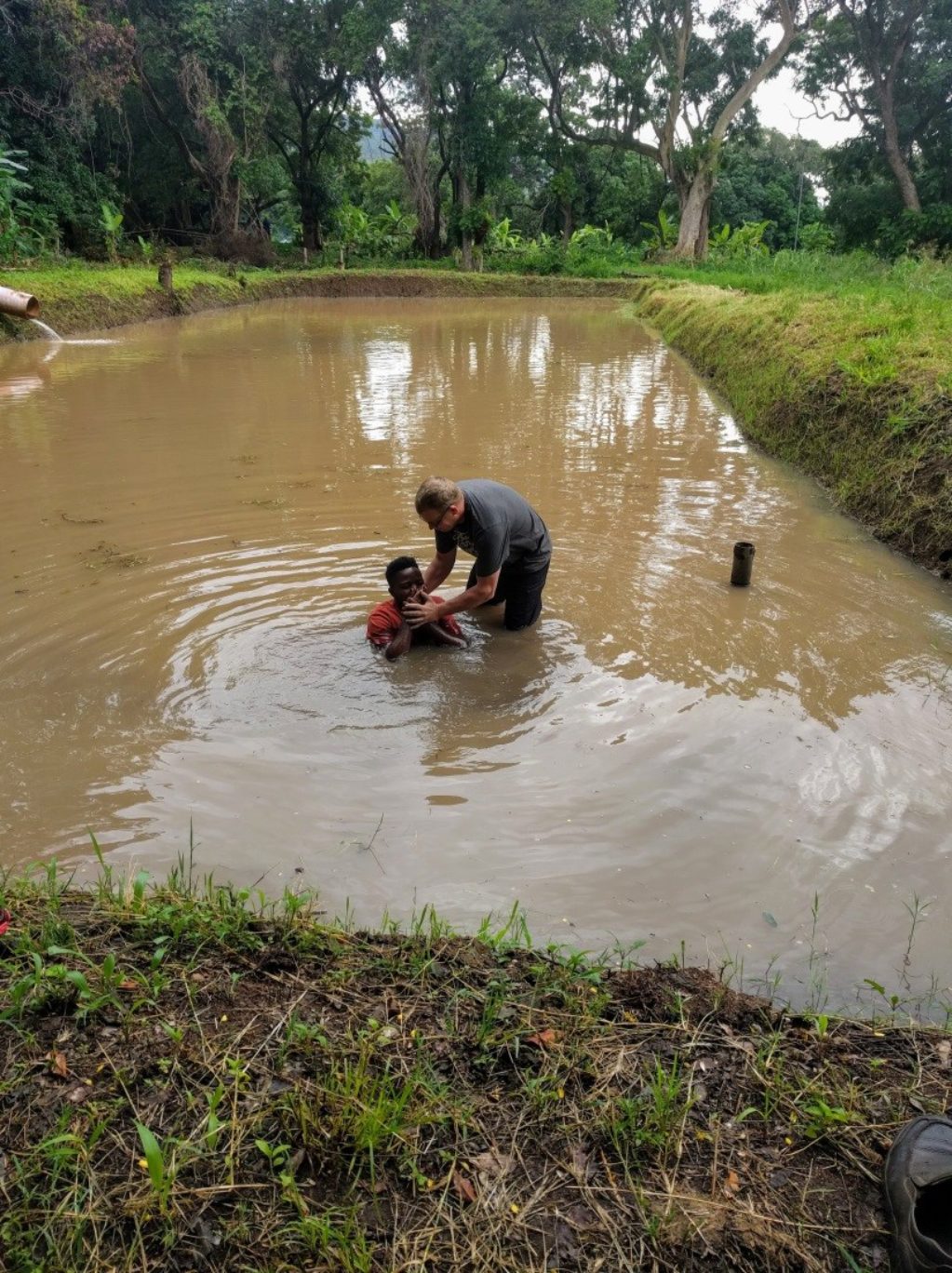
New brothers in Christ…Gage Coldwater baptizing John, one of the newly hired farm workers.
New brother in Christ…Gage Coldwater baptizing Watson, one of the newly hired farm workers.
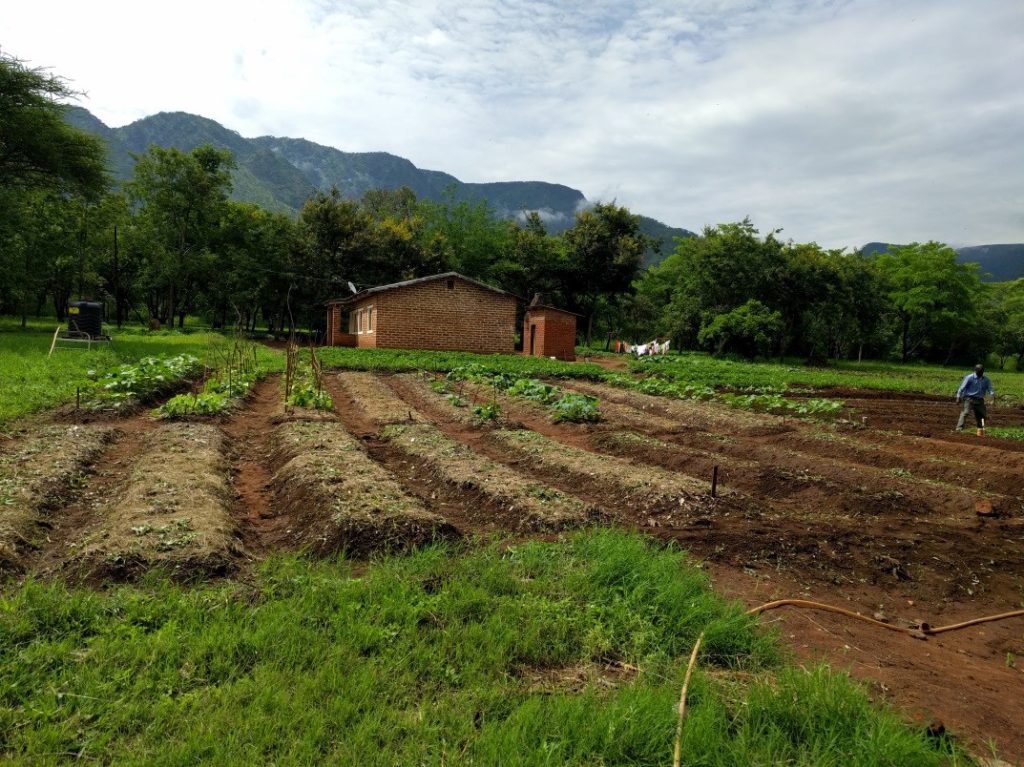
The beginning of the farm project with raised beds at Chimala Mission.
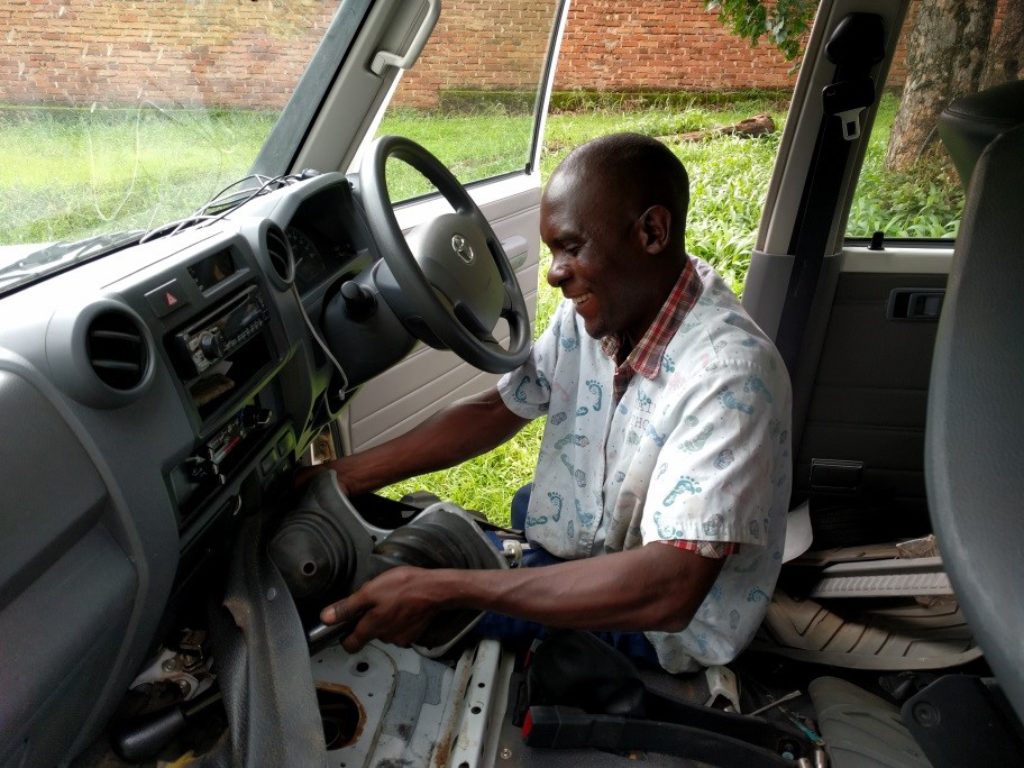
Land Cruisers are legendary for their off-road prowess; but good maintenance by men like James Blackwell (replacing a clutch) is key to surviving Tanzanian roads.
Aurora, Pike and Kelly Coldwater and Carol Rogers wait for the CSOP English students to receive their quilts.
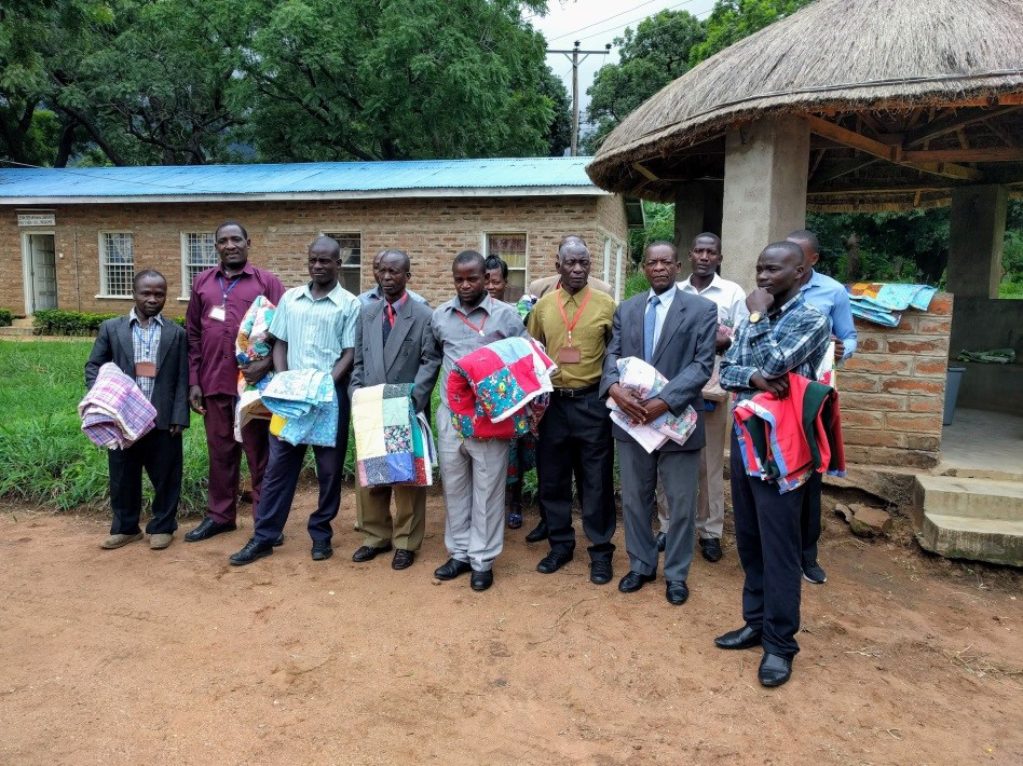
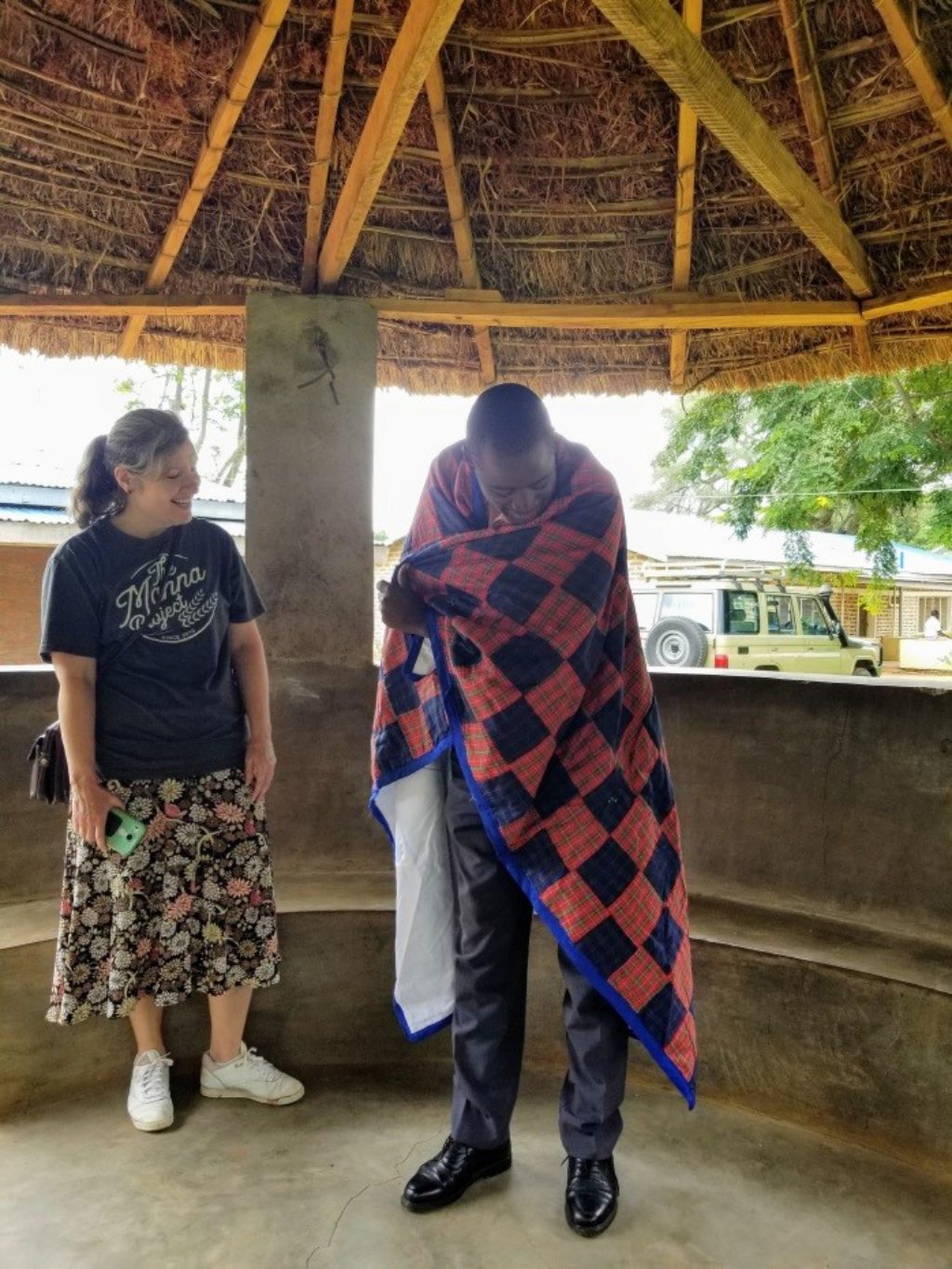
CSOP Swahili students receive new handmade quilts donated by generous hands of faithful supporters from churches of Christ in the USA.
A brief devotional at the mission hospital is always a good way to start the day as patients and staff hear the words of Jesus Christ, the Great Physician.
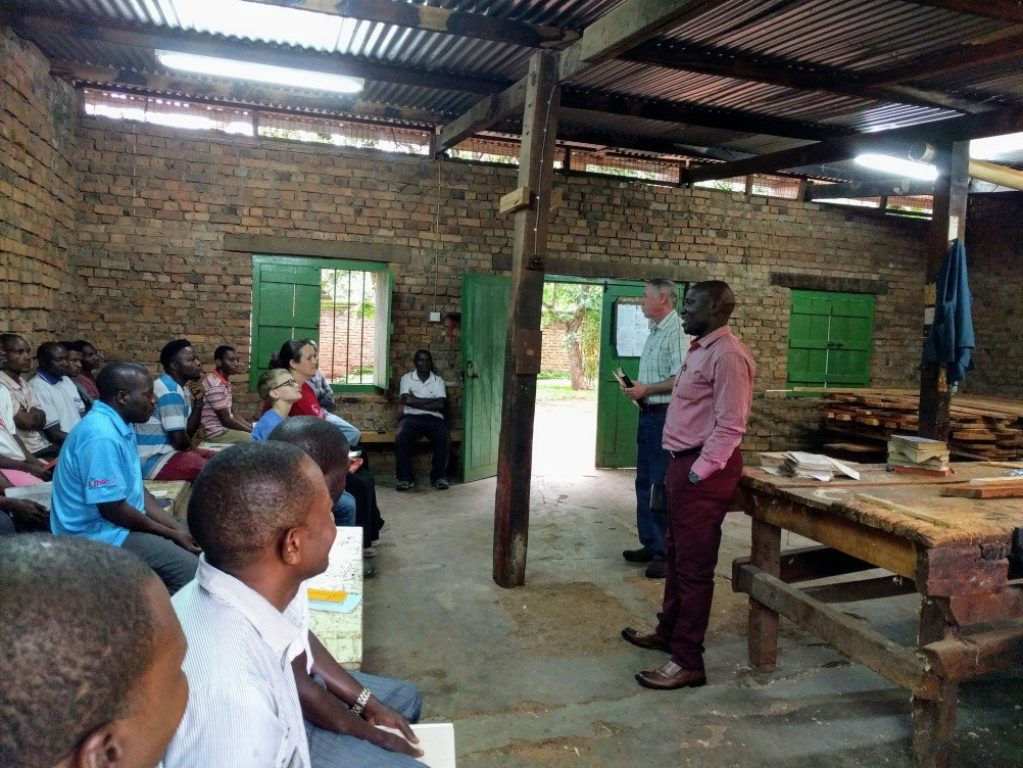
7:30 morning devotional at the mission estate shop. Every part of the mission has a morning devotional to start the day!
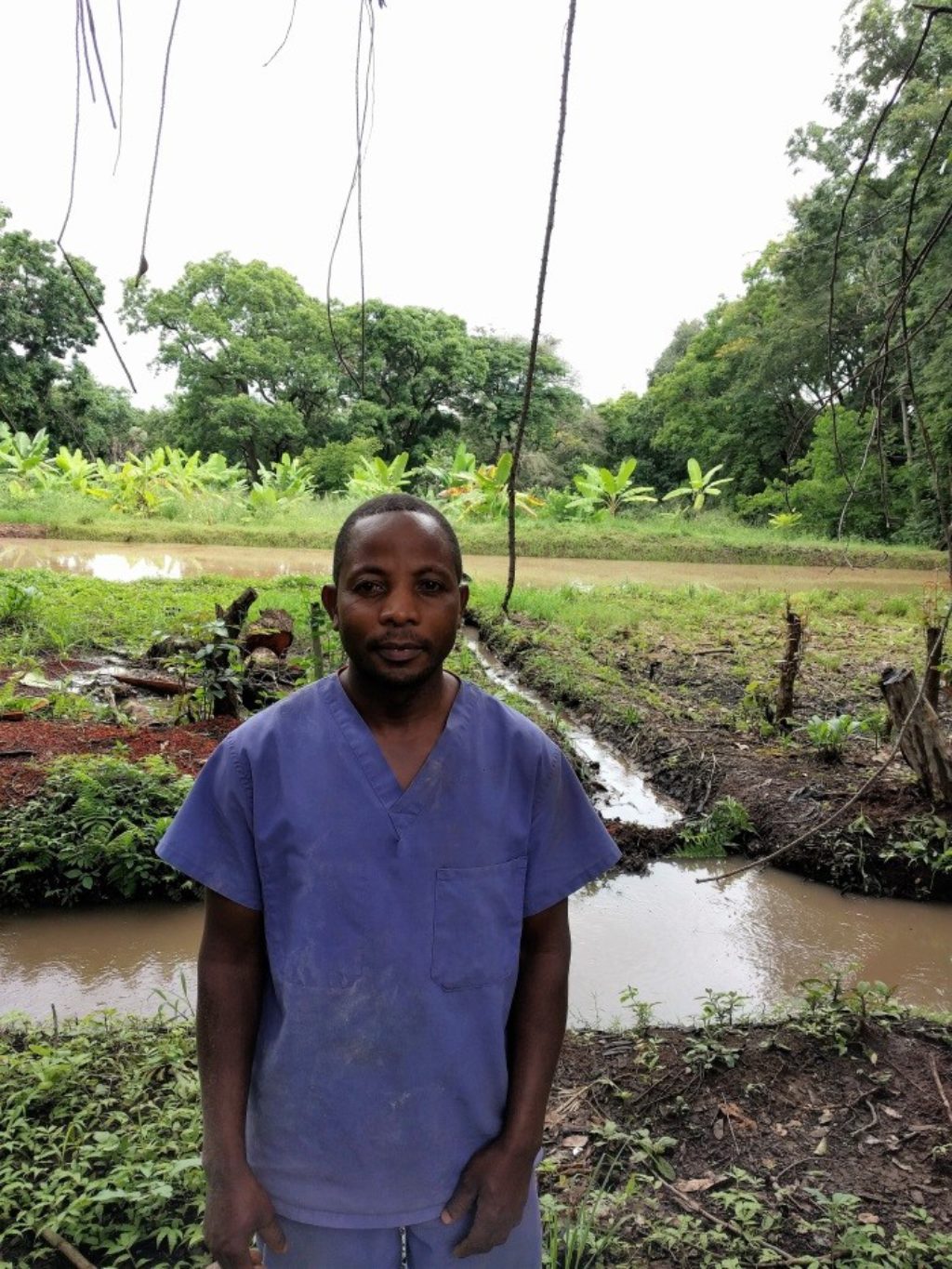
Naaman Sheiza, one of the farm workers and old friend of Howell’s from Arusha, stands in front of the tilapia pond.
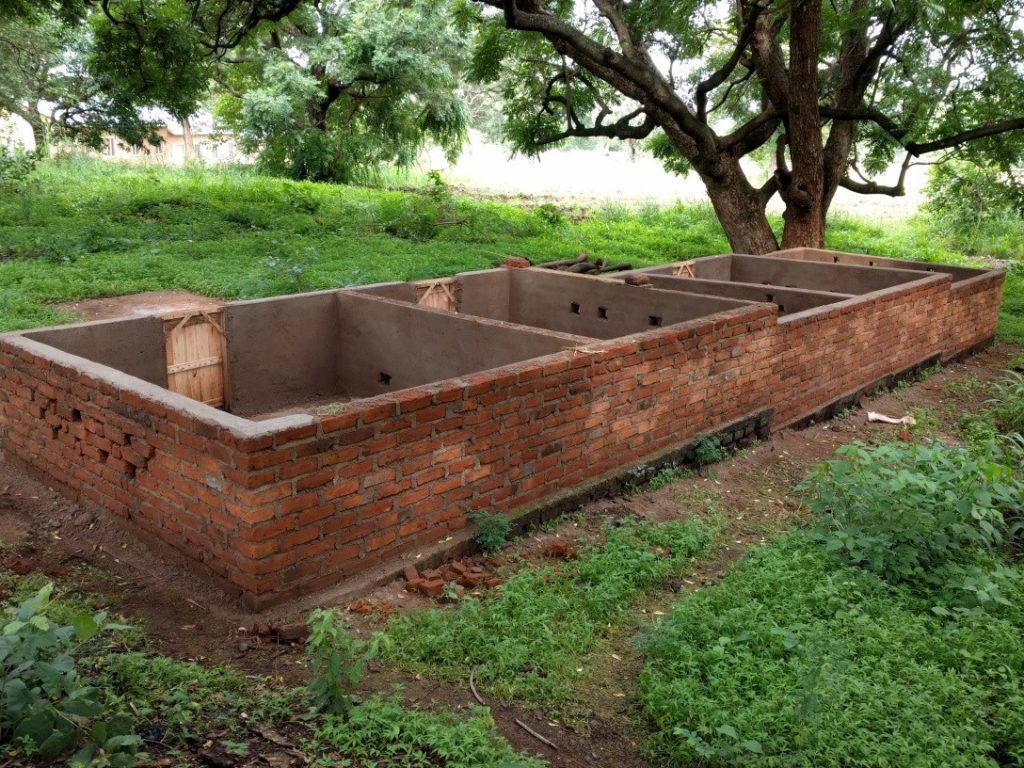
Foundation and walls of new pig stalls as part of the farm project.
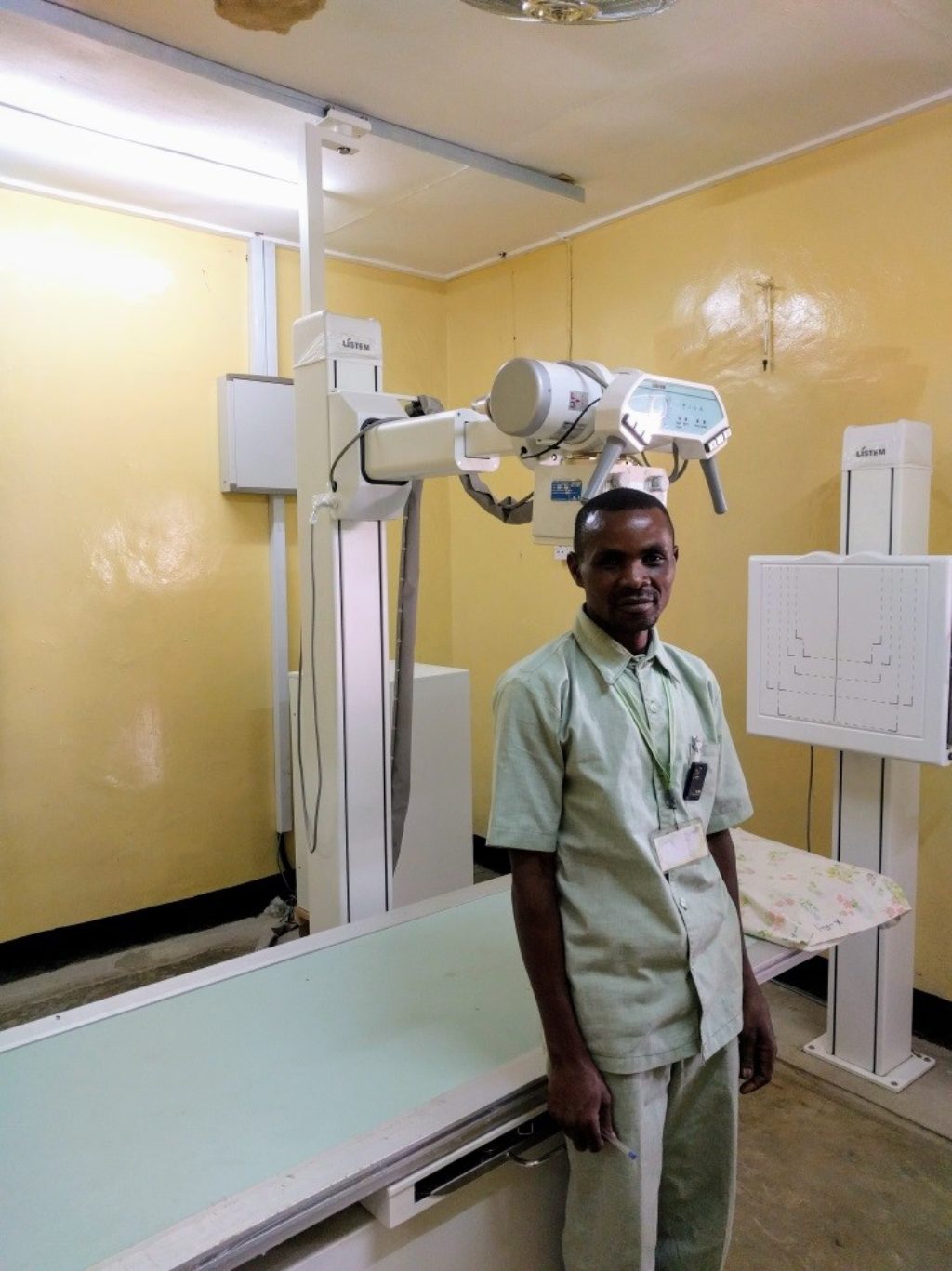
Radiographer Ochard stands in front of an x-ray machine donated to the mission.
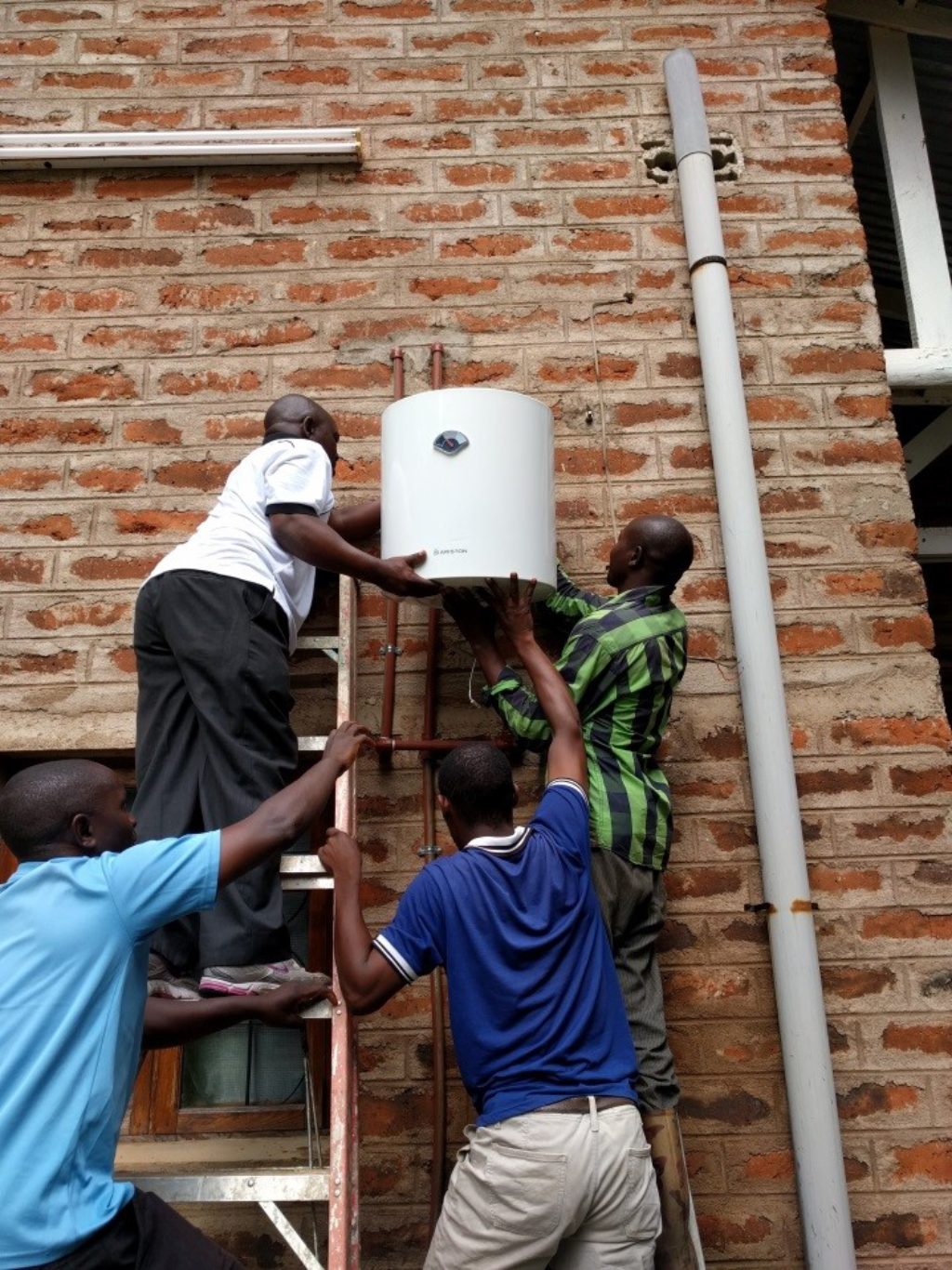
Keeping the Chimala Mission estate operational for our frequent guests and missionaries is a continuous challenge as when water heaters need replaced
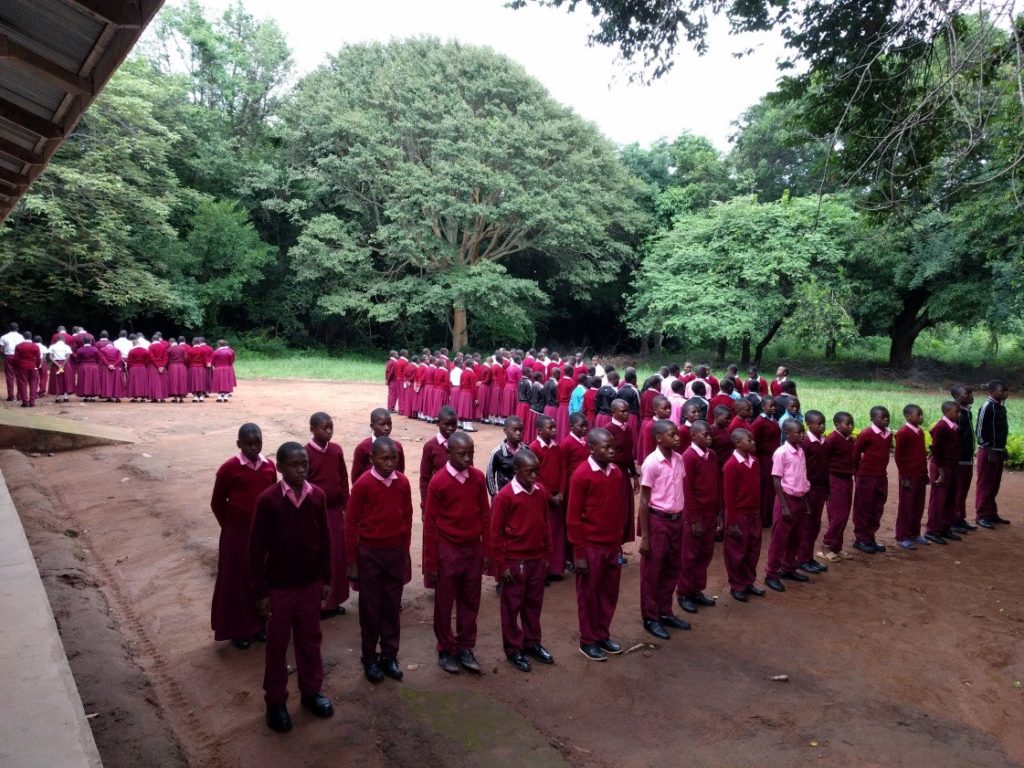
Students from the Herring Christian Secondary School stand at attention during drill and devotional time
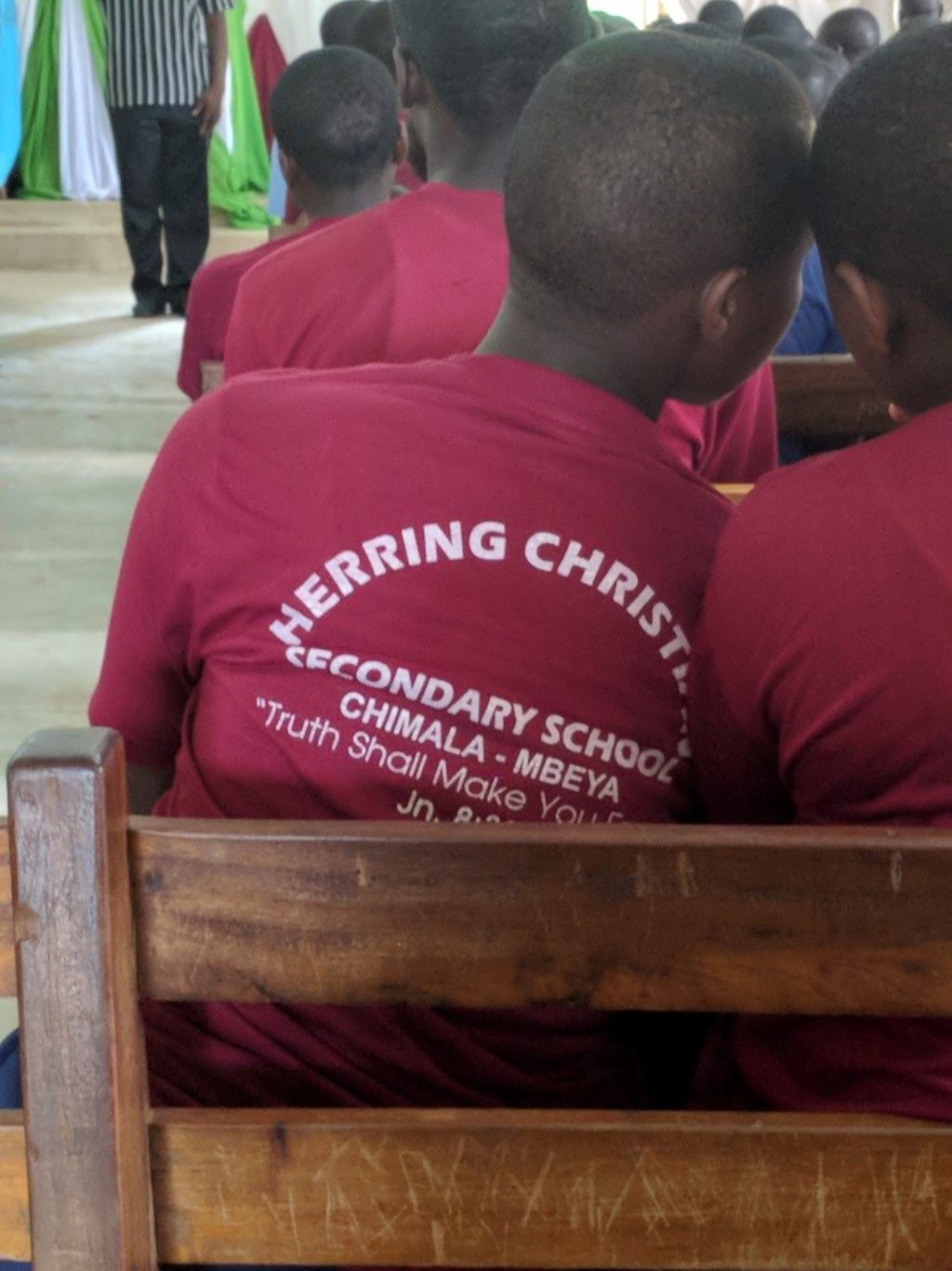
A Herring Christian Secondary School student during afternoon worship at the mission congregation
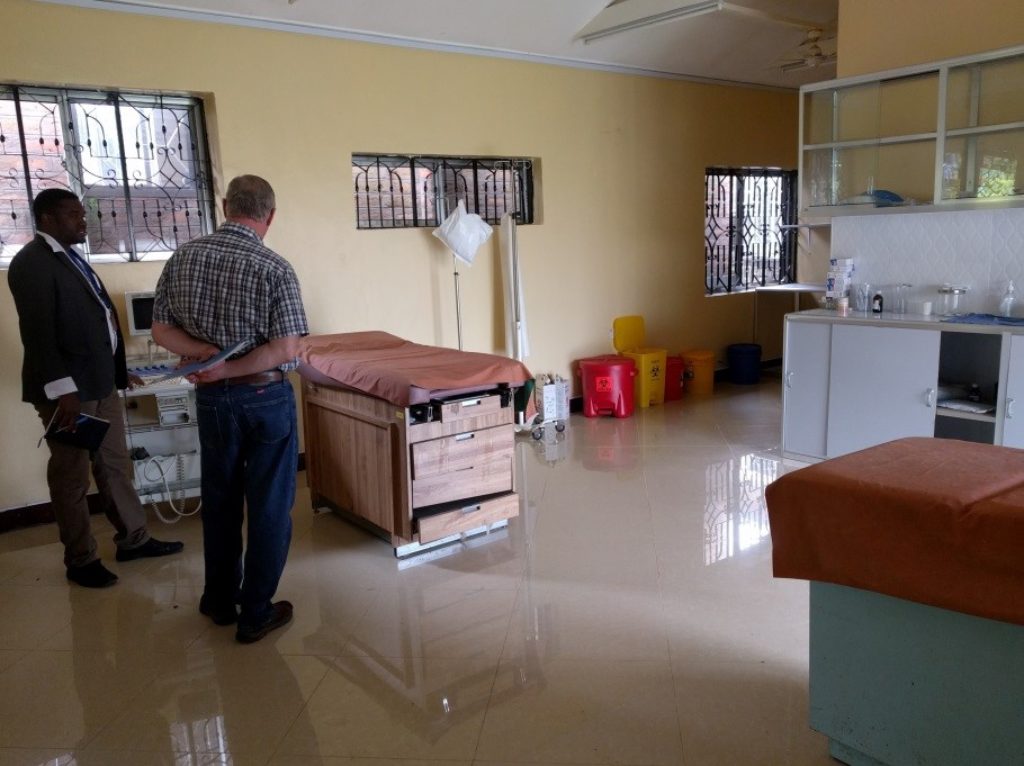
Shadrach Obely, Health Secretary at the Chimala Mission Hospital, gives a tour of the ER
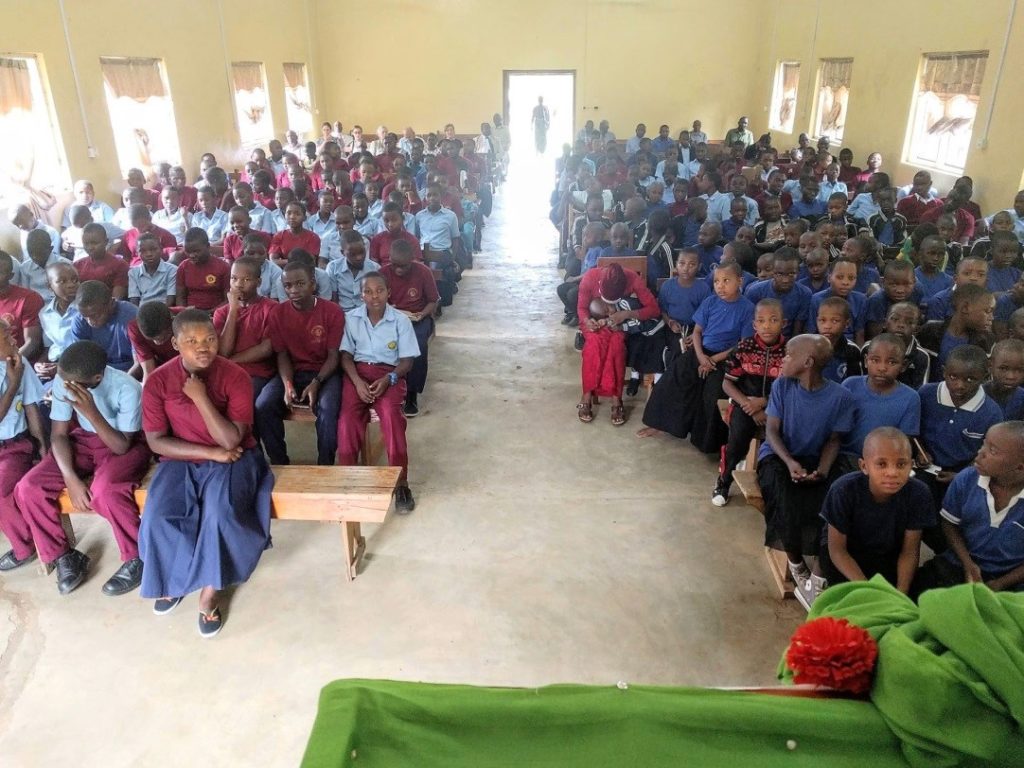
Sunday morning worship at the mission congregation with Chimala Mission primary and secondary school students attending
Mary looks on as a tall CSOP students is trying-on-for-size his new handmade quilt.
These are only a fraction of the activities and works that go on at the Chimala Mission. They are not just pictures, they represent the souls of people on a journey that will eventually take us all before our Creator. Making the gospel available in this far and remote part of Africa is what has made the Chimala Mission so invaluable to so many people.
Your continued prayers, encouragement and support help keep this vital effort in southern Tanzania alive. There is still much to do and many challenges yet to face. Meeting these challenges is frequently at a financial cost, as are all effective works of the Lord. But we are confident that our God shall supply all our need to accomplish His will through good people like you. God bless!
We are now finishing the fourth day of our first visit to the Chimala Mission for 2019. It began in a similar way to countless other trips to Tanzania that we have taken in the past. A short flight from Nashville to Washington, D.C; an 8-hour flight to Zurich, another 10-hour flight to Dar-es-Salaam; and finally a short trip to Mbeya followed by a 2 ½ hour drive to Chimala. Menard Swila, mission administrator picked us up for the drive. All our luggage made it, so we arrived at the mission around 5:30 pm. As hard as the trip is, this one was as uneventful and smooth as they come.
Richard and Carol Rogers arrived at Chimala a day earlier than us just coming off their furlough. Gage and Kelly Coldwater and their children, Aurora and Pike, have been here at the mission for about a month working with the new farm project. With all of us here we have been taking advantage of opportunities to eat together and get to know one another better.
The jet lag seems to
be a little more annoying than I remember. After waking up the last two nights feeling
like I’ve been asleep all night, and then to see the clock read 12:30, is a bit
frustrating. But the good coffee that I know is coming a few hours later is
worth the slight inconvenience. Speaking of inconvenience, the electricity has
been going out more than I would have guessed since it is the rainy season, and
the hydro-electric plants should have plenty of water in their rivers. But so
far we’ve woken to only one gully-washer early Saturday morning. I’m sure more
will come. The road up to the Ailsa mountain mission behind the Chimala Mission
is impassable. Consequently I may not be able to visit that work on this trip.
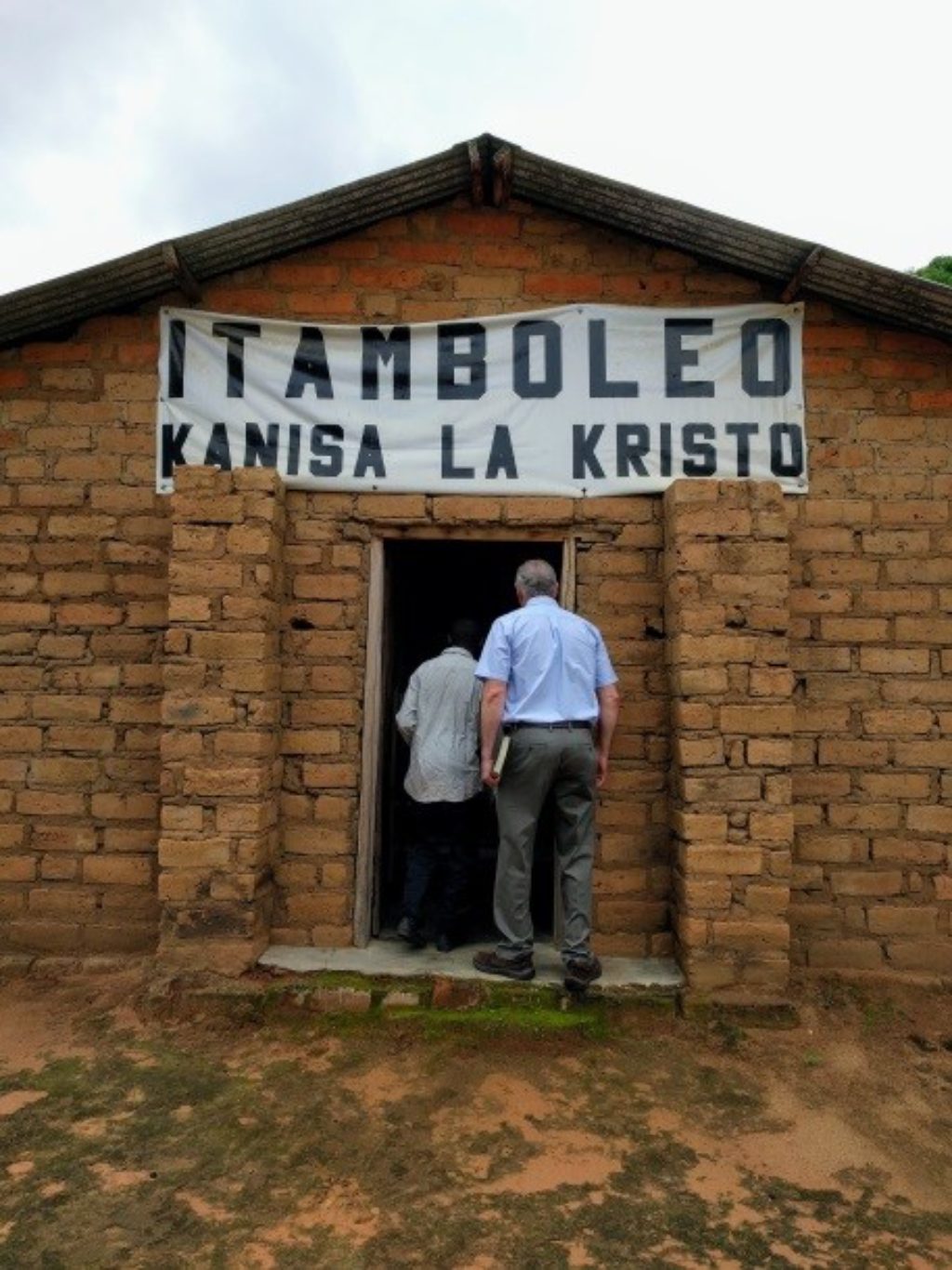
Walking into the building where the Itamboleo congregation worships.
Since our arrival to
Chimala started on a Friday, I have not disturbed the Chimala staff too much
due to the weekend. But at the same time I have been able to jump-start a few
discussions with Menard Swila—the mission administrator, as well as with
Richard concerning the Chimala School of Preaching, and Gage with the farm
program.
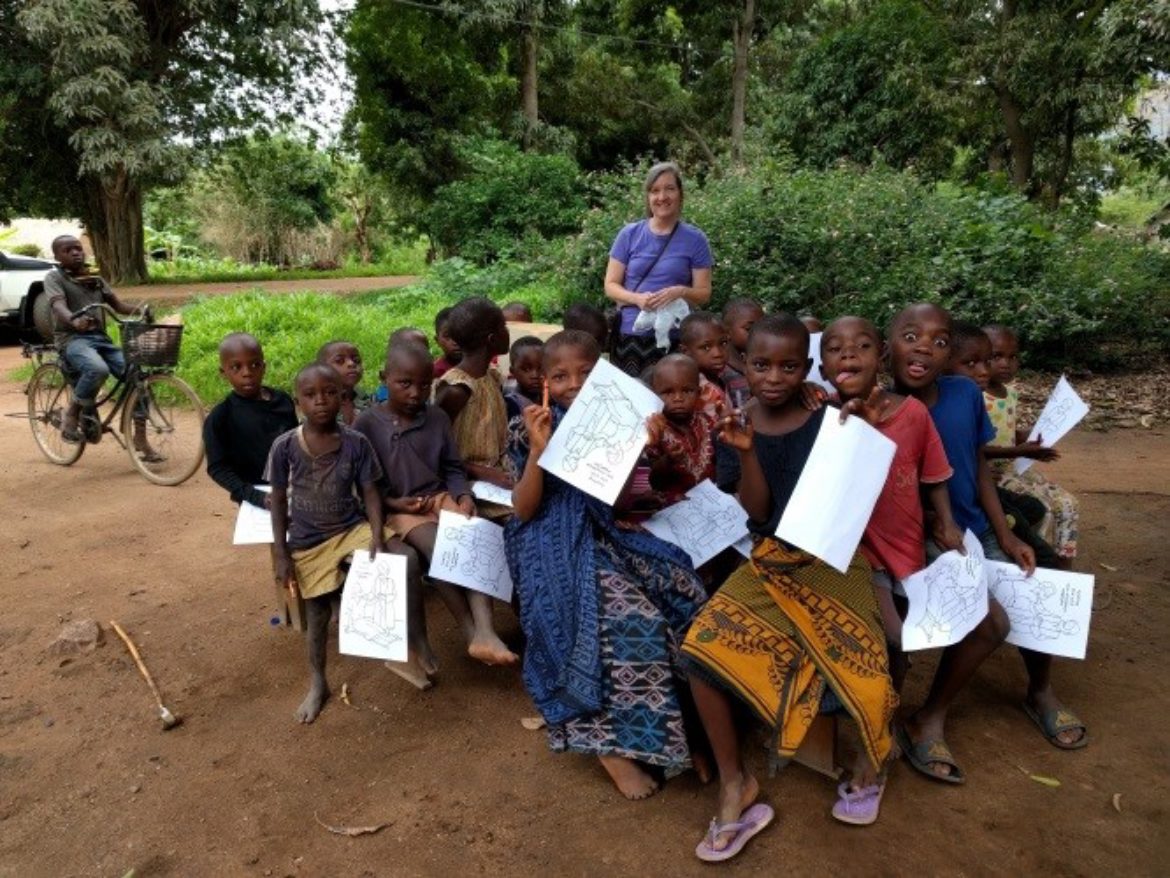
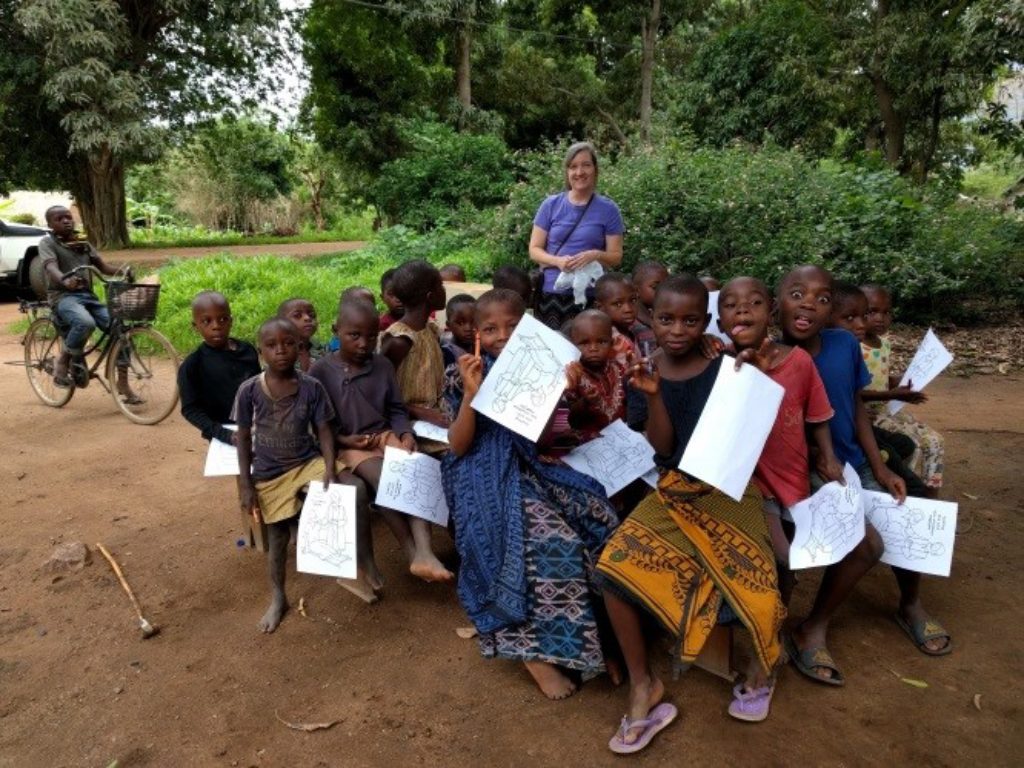
The children from the Chosi A. Village congregation wanting to hear Mary teach Bible classes.
This morning, we worshipped at Itamboleo, a little congregation a few kilometers west of the mission on the Great North Road. Although there were only around 15 in attendance, the voices of the Tanzanians rang loud and clear in that little brick building. A visiting preacher was prepared to speak there as part of a preaching rotation among some of the congregations. I was asked to say a few words to prepare the church to partake of the Lord’s Supper and to prepare them for the time of the collection. That afternoon, Menard, Mary and I traveled to one of our favorite village churches – Chosi A. And our going there was not so much for the few members to hear me, as it was for the group of small children that came from all directions to hear Mary teach Bible lessons using laminated sheets that she had made several years ago.
Just this evening
before sitting down to write this report, we enjoyed a tradition started by
Bill and Cyndi Stinson of eating pizza at one of the mission houses. Carol
asked everyone to come to her house where we crowded around a small oval table
enjoying great pizza.
Sitting down with Richard & Carol Rogers, and Gage & Kelly Coldwater to each pizza.
Tomorrow (Monday) morning will start the beginning of a very
busy week. Chapel at CSOP will begin at 7:30, as do all the chapel services
around the mission. The preacher students are returning to begin orientation
and the first day of school. On my computer I have already made a list of many
things I need to do including many meetings with department heads and
administrators. The entire mission will be buzzing with activity with the preaching
school, the hospital, the primary and secondary schools as well as all the
activities of the farm project and estate workers.
On a final note, Bill and Cyndi Stinson had to cancel their
flight to Chimala due to Bill having a health issue. Because he is facing
several tests, he is not sure when he will be able to come. Thankfully, he and
I have been discussing many areas about the mission as I have become the new
stateside coordinator beginning this year. So I ask that you pray for both Bill
and Cyndi as they face this health concern.
On a personal note, I would appreciate your prayers as I
just learned yesterday that my Mom was taken to the ER because her potassium
and sodium levels were low. She was then taken to CCU until her levels were
back to normal, and now she is doing much better.
I am grateful to God every day that He has entrusted His world-wide spiritual objectives to the hands of precious people like you who really care what happens to others. Your prayers, encouragement, and support are having a tremendous effect as the love and care for both the body and soul is demonstrated daily at the Chimala Mission.
It would not be a stretch to say that a good amount of effort has been spent in mission works in East Africa over the years. From the early efforts of men such as Eldred Echols who made his way from South Africa upward through Zimbabwe, Zambia, Malawi and eventually reaching Tanganyika (Tanzania’s former name under British rule), until the present efforts centered in Arusha, Chimala, and Dar-es-Salaam; Tanzania has frequently been the location of choice for many mission works in Africa. What makes Tanzania a desirable location from which to conduct mission work should not be viewed from its numerous national parks with exotic wildlife nor its moderate climate. Among the many benefits to the missionaries include the following significant factors:
The central location offers easier access for people of neighboring countries.
Generally speaking Tanzania is not an expensive location from which to operate missions.
It is a favorite location for Western, European, and Asian tourists which brings with it modern communication and better transportation linking it to a small number of major European and Middle Eastern airlines.
Tanzania is politically a continuously-peaceful country unlike many other African countries that are under constant instability and conflict.
Missionaries generally enjoy a friendly relationship with Tanzania’s government and people due to tourist generated income from foreigners who favor wildlife-protecting countries.
And let it not be overlooked that the country of Tanzania is home to nearly 60 million souls!
What this all means to evangelistic mission efforts is greater and more diverse connections with a greater number of people on the African continent as well as relative stability for missionaries.
These reasons and many more draw the attention of mission efforts that are seeking an efficient way to maximize the spread of the gospel of Christ in Tanzania and beyond. Among the places within Tanzania, the village of Chimala was one of the first locations of churches of Christ from which to launch mission efforts effectively. Over the years the mission has grown in influence and size and is likely to develop further in its effectiveness and influence. It is continually growing closer to becoming self-sufficient, self-ruling, and self-supported. For about a year now, one of the first graduates of the Chimala Bible Institute, Menard Swila has been serving as the Chimala Mission Administrator. This has been a first. And with new agricultural plans being implemented, the mission should be able to provide for itself more effectively in the way of being good stewards of the land.
You might be wondering why a mission of the church of Christ would be involved in agriculture. That is a good question. The answer lies in stewardship. Remember, the ultimate goal of the Chimala Mission Hospital and Schools is to “seek and save the lost” with the gospel of Jesus Christ. And a quick glimpse of Chimala’s history will shed a little light on the subject.
After the Lord’s church began to be planted and spread in Tanganyika, the government demanded that the American missionaries provide some type of “social” benefit to help the people or the church would lose its registration. And consequently the missionaries would have to leave. Andrew and Claudene Connally were serving in Tanganyika at that time. When they learned of this dilemma Andrew returned to the States. After discussing the condition with his elders, he began with their approval to raise support to build a hospital which was desperately needed in southern Tanganyika. This action prevented the government from reclaiming the land (over 700 acres) from the Chimala Mission, and the Lord’s church was able to maintain its registration in the country. But for many years now much of the land has been lying fallow.
There is another challenge that factors into this situation: the predicament of multitudes of small village churches without permanent preachers. This has been one of the great obstacles to be overcome by many otherwise successful mission efforts that strive to train indigenous preachers, leaders, and church workers. Most of the Christians in places like Tanzania are very poor rural people with little education and opportunities. While the Christians are taught to give, the total of their giving is very seldom enough to support the preacher and his family. Consequently, preachers either have to be supported (usually from churches in the States) which is undesirable and unsustainable in the long term, or they spend a great amount of their time farming in traditional, highly inefficient methods while the immature churches languish spiritually.
A solution that is being proposed is the implementation of a new farming plan. The basic goals of this proposal are outlined below by Gage Coldwater of “The Manna Project” in Vidor, TX :
Grow enough food for the ENTIRE Chimala mission.
EVENTUALLY grow enough to use as benevolence in the area.
EVENTUALLY grow enough to sell as a source of income to become a self-supported mission work.
To teach the students (primary, secondary, and preaching), mission staff, and area members of the Body of Christ to better grow their own food to be self-sufficient and for income.
To increase the quality of nutrition on the Chimala Mission.
Hopefully the idea of stewardship is now made a little clearer in respect to the land at Chimala Mission and the challenge of financing preachers. With God’s help the Chimala Mission can become a model for future development of new mission efforts and church plants. The age-old “Gordian knot” with respect to maintaining preachers in effective ministries in very poor areas could potentially be solved; at least in some instances since agricultural means may not work in every circumstance. As the Lord’s people continue to seek more effective means to reach the lost let it not be said of them, “For the sons of this world are more shrewd in their generation than the sons of light” (Luke 16:8). May we be good stewards of God’s things He has placed in our hands.
Our fall edition of “The Challenge of Africa” is now available. This edition includes some of the normal information about the work at Chimala and important updates about the work inside this edition.
One important update and bit of news is the change of oversight for Chimala Mission in 2019. Read in this newsletter about the Dalraida Church of Christ (Montgomery, AL) that will assume oversight in 2019.
Please continue to be a partner with us in this great work for the Lord’s Church. Download your copy of the newsletter by clicking below on the link or by visiting our Challenge of Africa Reports Page on our newly redesigned website.
We are excited to announce that Chimala Mission will be overseen by the Dalraida church of Christ starting January 1, 2019.
For 21 years, the New York Avenue Church of Christ has overseen this work in Tanzania. They have been such a great partner in this work and have helped to build this mission into a great resource for the people of Tanzania, especially the local church.
Dalraida Church of Christ is a mission-minded congregation in Montgomery, Alabama. After reaching out to several congregations of the Lord’s saints, we were excited to meet with them and accept their offer to oversee our work. Dalraida oversees various mission works around the world and commits more than one-third of their annual budget to missions. The Dalraida eldership sees the importance of carrying the gospel to all the world and fulfilling our obligation under the Lord’s Great Commission.
We are reaching out to all of our financial supporters — both individuals and congregations — and encourage everyone to continue supporting this work under the oversight of Dalraida. They believe in our mission, and together we continue to spread God’s saving message in Tanzania together.
You can download and read the letter sent from the Dalraida elders to all supporters below.
Today we went to Igawa, which is a congregation about 40 KN from the mission where one of my students preaches. He has been asking for us to come and this was out last opportunity to go before we head back to the States. We also took 7 students with us and they really enjoyed it as this was their first time to be at Igawa even though Msafuri (the preacher) had told them much about the congregation. Afterwards they had everyone over to provide us a meal. During our discussion after the services had ended, I found out that they (the students) really appreciate our inviting and taking them with us everywhere we go on Sunday’s. It seems that this had not been a practice of the missionaries in the past, and they were surprised that we had even asked them to go. While this has been a tremendous benefit to the students, it has also be a tremendous benefit to Carol and I. Over the past year we have been able to have all of the students with us on several occasions, and have gotten to know each one personally. We have been able to watch them grow and develop, and also encourage them in their service to God. It is exciting to also see how they have taken an active part int he services and have grown in this area also. This Sunday was out last time together for this year as our school year ends with Friday’s graduation and then everyone will be heading home until January. Also, we will begin out journey back to the states next Monday – November 5.
Speaking of our trip, all of our tickets have been brought for all of our various travels, and I will soon get the itinerary together and post it so everyone can know were we will be and when. We look forward to seeing everyone again this year.
One final note, as of last Sunday it is official. The Dalraida church of Christ in Montgomery, AL will be taking over the oversight of the Chimala Mission starting January 1. We are scheduled to meet with them in mid-December.